How to read an eye prescription

Figuring out how to read your eye prescription can be a real challenge and may feel like you're reading a different language. All those letters and numbers have important meanings when it comes to your eyewear, so we’re here to help.

Eye prescription terms & abbreviations

Your glasses or contact lens prescription may be digital or on paper. Either way, it will contain a chart that lists numbers, abbreviations, and sometimes words to define your eye prescription. Here are common eye prescription abbreviations and what they mean:

OD (Oculus Dextrus):

Refers to your right eye, is always listed before your left eye.

OS (Oculus Sinister)

Refers to your left eye. 

OU (Oculus Uterque)

Refers to both your eyes.

D (Diopter)

This is represented by a number on your eye prescription that shows how much focusing power is needed to correct your vision.

Pupillary Distance

This number is the distance between your pupils, which is important for ensuring the center of each prescription lens aligns with the center of each pupil.

- (Minus Sign)

A negative sign in front of the diopter number means you’re nearsighted.

+ (Plus Sign)

A plus sign in front of the diopter number means you’re farsighted.

DV (Distance Vision)

Another way to note farsightedness.

NV (Near Vision)

Another way to note nearsightedness. 

Glasses prescription terms

Your glasses prescription will appear like a small chart with columns and rows. The rows indicate which eye (right or left) the prescription is for, and the columns indicate the following:


Glasses

Power (PWR) or Sphere (SPH)

This shows whether you’re far (+) or nearsighted (-) and how much correction your eyes require.

Cylinder (CYL)

CYL represents the added correction for astigmatism and is usually a value between -2.25 and -0.75. Astigmatism is a common imperfection that’s found on the eye’s surface or inside your eye, which causes blurry vision.

Axis

This describes the position of the astigmatism in the eyes. Axis numbers are represented by degrees ranging from 1 to 180 on your eye prescription.

Addition (ADD)

This describes the additional magnifying power required to correct presbyopia (a common condition of aging eyes) and is usually prescribed to those needing multifocal types of lenses. The number is typically the same for both eyes and is always a positive number.

Prism

This is a rare term used to prescribe prismatic power for those with eye alignment problems. Prismatic power is used to help correct diplopia, or double vision. The prism bends light to help align the vision so only a single image is seen.

Contact lens prescription terms

If you receive a contact lens prescription, there are additional terms and abbreviations to help with eye prescription meaning:

Power (PWR) or Sphere (SPH)

On a contact lens prescription, you may see the SPH written as Power, which is the strength of your prescription. These terms are interchangeable. This shows whether you’re far (-) or nearsighted (+) and how much correction your eyes require.

Base Curve (BC)

The base curve, which is usually a number between 8 and 10, measures the curve of the lens and helps determine how comfortable the contacts are.

Diameter (DIA)

The diameter indicates the width that best fits your eye and is usually a number between  13 and 15.

Brand

Your contact lens prescription must include the brand of contacts being prescribed as there are different parameters set by individual manufacturers.

How to read a glasses prescription

How to read a glasses prescription

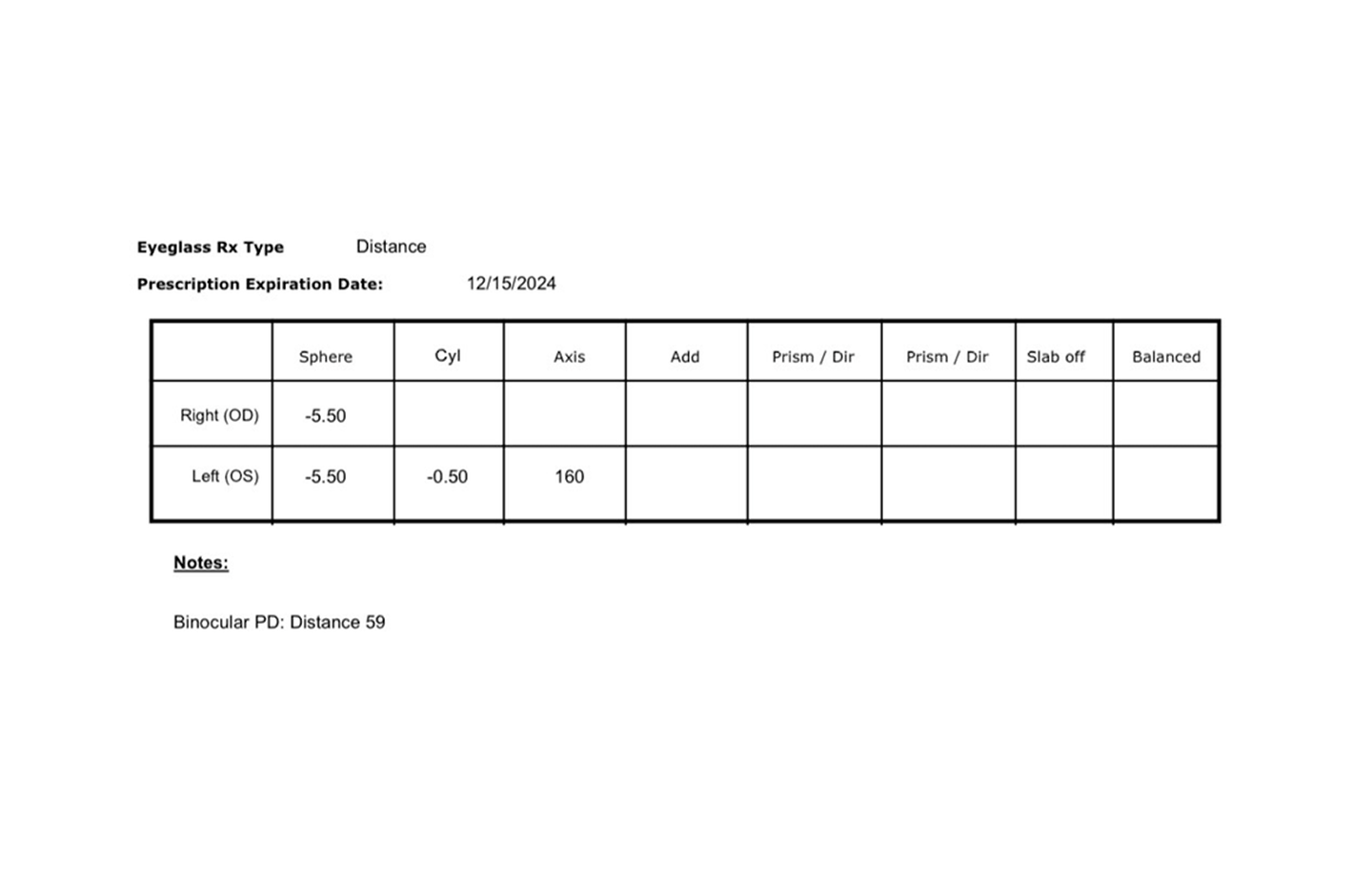
  • Identify which eye you are reading a prescription for. The right eye is noted as OD; the left eye is noted as OS.


  • Begin reading from left to right for each eye. We’ll start with the right (OD) eye under the first column, which is Sphere (SPH). This prescription says the Sphere is -5.50, which means this person has -5.50 diopters of nearsightedness. A plus (+) sign would indicate the person is farsighted. As numbers get farther from zero, either positive or negative, your glasses prescription will be stronger.


  • Begin reading the row for the left eye (OS), starting under Sphere, which is the same prescription as the right (-5.50). Therefore, both eyes have the same level of nearsightedness accounted for in the prescription.


  • Next, check the Cylinder (CYL) column, which shows -0.50 of astigmatism.


  • Read the Axis column (noted in degrees from 1 to 180) to see where this person’s astigmatism is located on the cornea, which reads 160.


If this person had additional lens power on their eye prescription, it would be noted in the Add column. For example, bifocals or progressive (multifocal) lenses may be indicated in this column, to show the additional lens power needed so you can use the glasses for reading or other corrections without needing another pair of glasses.

How to read a contact lens prescription

How to read a contact lens prescription

After your contact lens exam (or fitting), you’ll receive a prescription similar to an eyeglass prescription, but with a few additional columns that are specific to contact lenses.
 

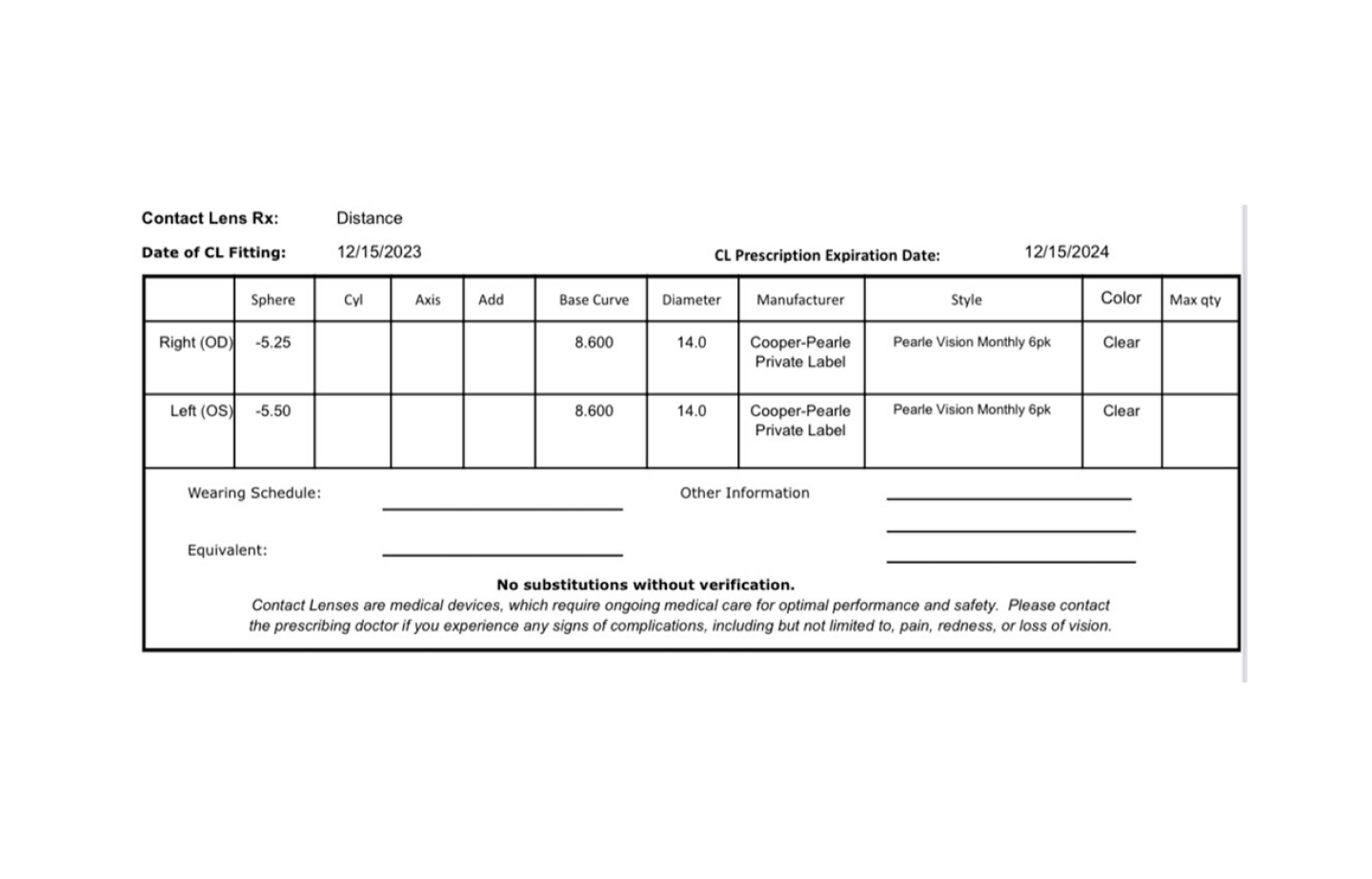
  • Identify which eye you are reading a prescription for. The right eye is noted as OD; the left eye is noted as OS.


  • Begin reading from left to right for each eye beginning with the first column, Sphere. This prescription says the right eye is -5.25, which means this person has -5.25 diopters of nearsightedness. The left eye is -5.50, which is slightly more diopters than the right eye.


  • The base curve (BC) for the right and left eye is 8.600. This shows how flat or curved the lens will be. The higher the number, the flatter the lens.


  • Next, check the diameter (DIA), which is 14.0 for both eyes. The DIA is the diameter of your contact lens in millimeters, so each eye has a lens that’s 14.0mm.


  • Check the brand you’re being prescribed in the column marked Brand or in this case, Manufacturer.


  • The Style column indicates the type of prescription package (quantity and refills).


  • This prescription indicates the color of contact lenses the person is asking for, which is Clear.


  • Confirm the expiration date, which is noted above the prescription chart as 12/15/2024, exactly one year from the time of the contact lens fitting.

You have a right to your eye prescription


Your eye care provider is required by law to provide you with a copy of your prescription after your eye exam. For contact lens prescriptions, you will receive the prescription after the fitting. The provider can’t make you pay additional fees for the prescription, obligate you to purchase from them, or make your sign a waiver. Some states may allow eye care providers to charge fees for certain tests or contact lens fittings; however, that does NOT prevent them from giving you a prescription BEFORE you choose to purchase glasses or contacts.

How long is your eye prescription good for?

How long is your eye prescription good for?

The length of time an eye prescription is good for can vary depending on the state requirements and your specific eye care needs.


Generally, prescriptions are good for 1 to 2 years and should clearly indicate the expiration date on the script. If your prescription has expired, make sure to schedule an eye exam.


It’s important to have a current prescription and annual eye exams to maintain optimal eye health and clear vision. Regular exams can help your provider identify conditions like glaucoma, which don’t have obvious symptoms, and correct your vision to avoid blurriness, headaches, eye pain, or strain.


If you have more serious eye conditions, your provider may recommend eye exams twice a year or as needed.

Renew or fill your eye prescription with Pearle Vision

Knowing how to read an eye prescription empowers you to better understand your eyes and communicate with your provider about your needs.
Here at Pearle Vision, we are here to support you on your journey toward optimal eye health.

Choose your location

Schedule an eye exam

Add to calendar

FAQ

Stay up-to-date

Get the latest on our special deals, new collections, and more.

*Eye exams available by Independent Doctors of Optometry at or next to Pearle Vision. Doctors in some states are employed by Pearle Vision.

© 2026 Pearle Vision. All Rights Reserved.

How to Read Eye Prescription | Pearle Vision